
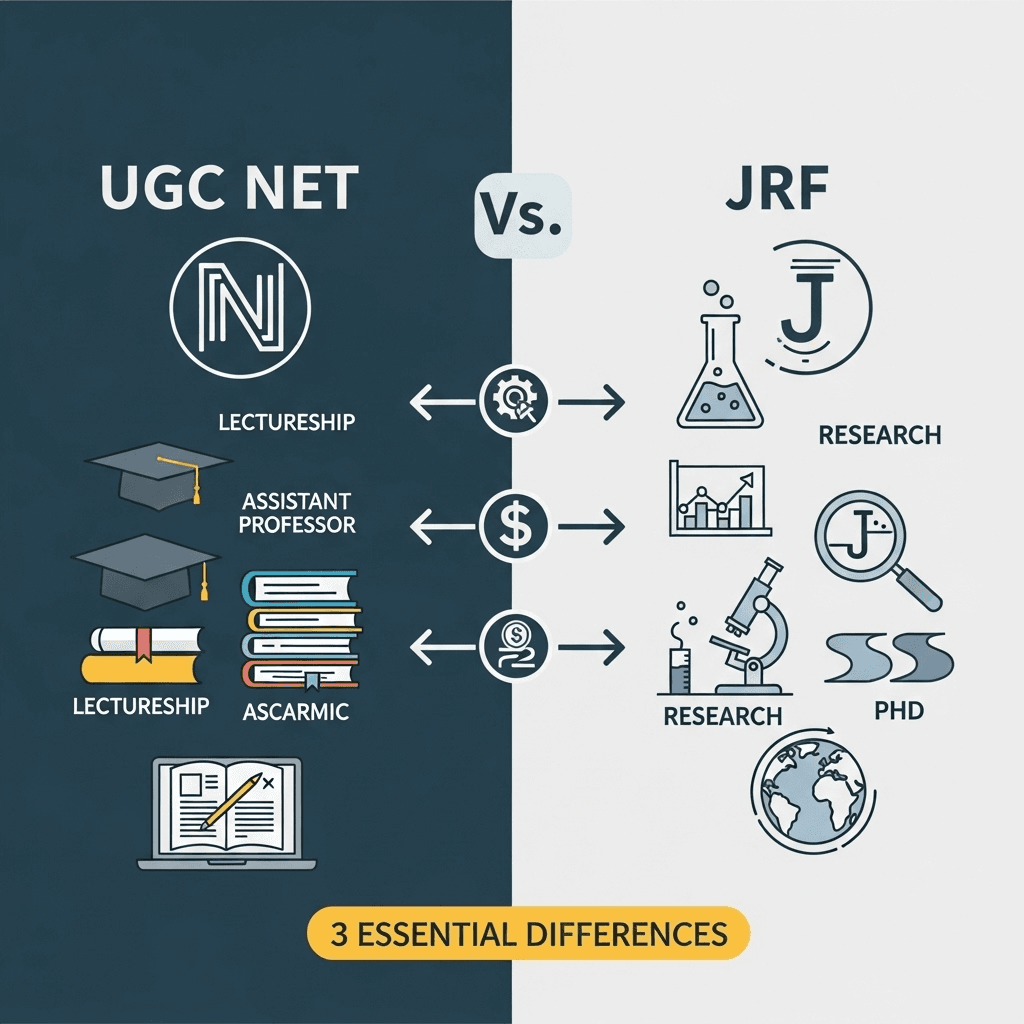
Dear UGC NET aspirant, Ph.D. applicant, or aspiring educator, are you curious about the path to a thriving academic career in India? Understanding the nuances of the UGC NET examination is your first step. Let’s decode a common question that often puzzles many: What exactly is the difference between UGC NET and JRF?
UGC NET vs. JRF: Decoding the Difference for Your Academic Journey
For anyone aspiring to a career in Indian higher education, the UGC NET exam is a critical milestone. It’s the gateway to becoming an Assistant Professor or securing a coveted Junior Research Fellowship (JRF). While the exam is singular, the results it yields can open two distinct, yet equally fulfilling, career paths. Let’s delve deep into the UGC NET vs JRF difference and clarify how these two outcomes shape your academic future.
Understanding the Foundation: What is UGC NET?
The National Eligibility Test (NET) is conducted by the National Testing Agency (NTA) on behalf of the University Grants Commission (UGC). Its primary purpose is to determine eligibility for two things:
- Assistant Professor: This qualification makes you eligible to apply for teaching positions in universities and colleges across India. It’s the minimum requirement to step into the classroom at the higher education level.
- Junior Research Fellowship (JRF): This is a highly competitive and prestigious award that provides financial assistance to candidates who wish to pursue research, typically leading to a Ph.D. degree.
In essence, UGC NET is the umbrella examination. Cracking it is crucial, whether your aim is to teach or to dedicate yourself to research.
Demystifying JRF: What is Junior Research Fellowship?
The Junior Research Fellowship (JRF) is not a separate exam but an award based on your performance in the UGC NET exam itself. Among the lakhs of students who appear for the UGC NET, only a very small percentage (typically the top 1% to 6%, depending on categories and subjects) are awarded JRF. This means if you qualify for JRF, you automatically qualify for Assistant Professor eligibility as well.
Think of JRF as a golden ticket for research. It provides a monthly stipend and other allowances for a period of five years (or until the completion of your Ph.D., whichever is earlier), allowing you to focus solely on your research work without financial worries. It’s a significant boost for anyone looking to make a mark in academic research and innovation in India.
The Core Difference: UGC NET vs JRF Distinction
While both Assistant Professor eligibility and JRF are outcomes of the same UGC NET examination, their purpose, benefits, and the level of achievement required are vastly different. Understanding this UGC NET vs JRF difference is paramount for strategic preparation.
Eligibility Criteria: A Key Divergence
The basic academic eligibility criteria for appearing in the UGC NET exam are similar for both Assistant Professor and JRF categories (a Master’s degree with a certain percentage of marks). However, a significant divergence lies in the age limit:
- For Assistant Professor Eligibility: There is no upper age limit. Whether you are a fresh postgraduate or an experienced professional looking for a career switch to academia, you can appear for the NET exam to qualify for Assistant Professor.
- For Junior Research Fellowship (JRF): There is an upper age limit. Generally, candidates should not be more than 30 years of age for the general category (with relaxations for OBC, SC/ST, PwD, and women candidates). This makes JRF a more time-sensitive goal for many aspirants.
This age factor often determines if a candidate is eligible for JRF at all, even if they score high enough. It’s a crucial point of distinction when planning your exam attempt.
Purpose and Benefits: More Than Just a Certificate
The fundamental difference lies in what each qualification empowers you to do:
UGC NET (Assistant Professor Eligibility) Benefits:
- Teaching Career: The primary benefit is becoming eligible to apply for Assistant Professor positions in any Indian university or college. This is the first step towards a fulfilling teaching career in higher education.
- No Direct Financial Grant: Qualifying for Assistant Professor eligibility does not come with any direct financial fellowship or stipend from the UGC. Your earnings would depend on your salary once you secure a teaching position.
- Lifelong Validity: Once you qualify for Assistant Professor, your eligibility remains valid for life. You can apply for teaching jobs at any point in your career.
Junior Research Fellowship (JRF) Benefits:
- Financial Support for Research: This is the biggest draw. JRF provides a significant monthly stipend (currently around Rs. 31,000 for JRF and Rs. 35,000 for SRF, plus HRA and contingency grants, though these figures are subject to change by UGC) for five years, enabling you to pursue full-time Ph.D. research.
- Boost for Ph.D. Admission: Holding a JRF significantly enhances your chances of getting admission into top Ph.D. programs in premier institutions across India, as you bring your own funding.
- Research Exposure and Networking: It allows you to dedicate yourself to research, work with experienced professors, publish papers, and attend conferences, building a strong research profile.
- Prestige: JRF is a highly competitive and prestigious award, demonstrating your aptitude for research and academic excellence.
- Validity: The JRF award is valid for a limited period (usually two years from the date of the result) to join a Ph.D. program. Once you join, the fellowship continues for five years or until your Ph.D. submission.
Cut-off Marks: A Higher Bar for JRF
This is where the rubber meets the road. To qualify for JRF, you need to score significantly higher than what is required for Assistant Professor eligibility in the same UGC NET examination. The NTA releases separate cut-off marks for JRF and Assistant Professor for each subject and category. For example, if the cut-off for Assistant Professor in Commerce might be 55%, the cut-off for JRF in Commerce could be 65% or even higher. It’s truly about performing among the top percentile of candidates.
JRF vs Assistant Professor: Charting Your Career Path
Your performance in the UGC NET exam can lead you down two distinct, yet often interconnected, career paths:
Path 1: The Research Trail (JRF)
If you qualify for JRF, your immediate and most beneficial next step would be to enroll in a Ph.D. program. This path is ideal for those who have a strong inclination towards in-depth research, academic scholarship, and contributing to new knowledge. With the JRF fellowship, you can pursue your doctoral studies without financial constraints, often leading to a career as a research scientist, a university professor (post-Ph.D.), or even a policy analyst based on your research area.
Path 2: The Teaching Avenue (Assistant Professor)
If you qualify only for Assistant Professor eligibility, your path is directly geared towards teaching. You become eligible to apply for entry-level teaching positions in universities and colleges. Many individuals start their teaching careers this way and then pursue their Ph.D. while teaching (either part-time or by taking study leave). This path allows you to immediately step into the classroom, mentor students, and share your knowledge.
It’s important to remember that these paths are not mutually exclusive. Many JRF holders eventually become Assistant Professors after completing their Ph.D., and many Assistant Professors pursue their Ph.D. to enhance their career progression and research capabilities.
How to Aim for Both: Maximizing Your Potential
Given that JRF requires a higher score, aspiring for JRF automatically means you are preparing to qualify for Assistant Professor eligibility. The strategy, therefore, should always be to aim for the JRF cut-off. This approach ensures you push your limits and achieve the best possible score.
Here’s how you can maximize your chances:
- Comprehensive Syllabus Coverage: Go beyond the basics. Cover every topic in your syllabus thoroughly.
- Deep Understanding: Don’t just memorise; understand concepts. This is critical for tackling analytical and application-based questions, which are common in UGC NET.
- Regular Mock Tests: Practice, practice, practice! Mock tests help you manage time, identify weak areas, and get accustomed to the exam pattern.
- Previous Year Papers: Analyse previous years’ question papers to understand question types, important topics, and the difficulty level.
- Strategic Study Plan: Create a realistic study timetable and stick to it. Consistency is key.
This is precisely where expert guidance becomes invaluable. At UGC NET Coaching, we understand the nuances of the UGC NET vs JRF difference in terms of preparation intensity. Our meticulously designed courses, led by experienced faculty who have themselves cracked the exam and mentored thousands, are geared towards helping you not just clear the NET but to secure that highly coveted JRF.
Your Journey with UGC NET Coaching
Navigating the UGC NET exam, especially when aiming for the JRF, can feel overwhelming. This is where UGC NET Coaching steps in as your trusted mentor and guide. We provide comprehensive support tailored to your needs:
- Expert Faculty: Our educators are subject matter experts with proven track records, offering insights that go beyond textbooks.
- Holistic Study Material: We provide well-researched, up-to-date, and easy-to-understand study material covering both Paper 1 and your chosen subject.
- Targeted Coaching: Our programs are specifically designed to help you cross the higher JRF cut-offs, focusing on conceptual clarity and advanced problem-solving techniques.
- Regular Mock Tests and Performance Analysis: Our simulated exam environment and detailed feedback help you identify your strengths and weaknesses, ensuring continuous improvement.
- Doubt Clearing Sessions: We ensure all your queries are addressed promptly, building your confidence.
- Personalized Mentorship: We believe in a personalized approach, offering guidance on study strategies, time management, and mental preparedness.
We don’t just prepare you for an exam; we prepare you for a successful academic career. Whether your dream is to shape young minds as an Assistant Professor or to delve into groundbreaking research as a JRF, UGC NET Coaching is committed to helping you achieve it.
In conclusion, while UGC NET is the common examination, qualifying for Assistant Professor or JRF depends on your score and age. JRF is a higher achievement, providing financial backing for your research dreams, while Assistant Professor eligibility opens doors to teaching roles. Both are noble pursuits and contribute significantly to the academic landscape of our nation.
Ready to turn your academic aspirations into reality? Don’t leave your success to chance. Connect with UGC NET Coaching today and take the first definitive step towards securing your future in Indian academia!
Contact us now for a free counselling session and let’s chart your path to success together!

![UGC NET Preparation: The Ultimate Guide to Ace Your Exam [Proven Strategies]](https://ugcnetcoaching.com/wp-content/uploads/2025/08/image-1.png "UGC NET Preparation: The Ultimate Guide to Ace Your Exam [Proven Strategies] 4")